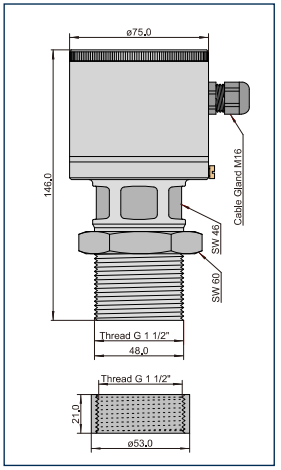
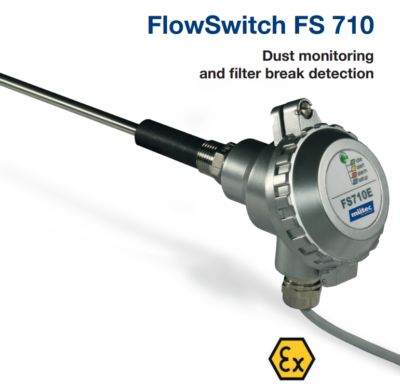
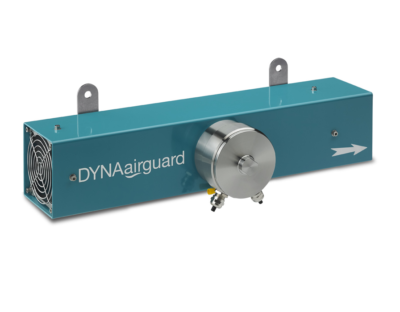
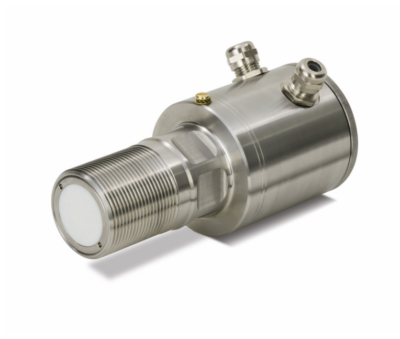
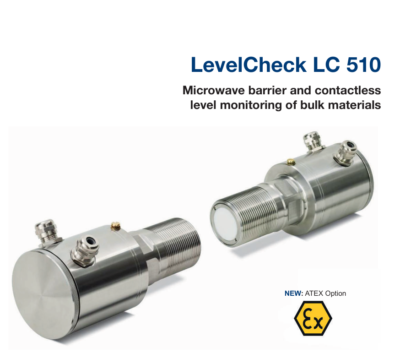
The FlowSwitch FS 510 is a contactless microwave flow switch designed to detect the movement of bulk solids in industrial conveying systems. Instead of measuring flow rate, it continuously monitors whether material is moving and immediately detects abnormal conditions such as flow interruption, blockages, or insufficient material supply.
Unlike mechanical flow switches that rely on direct contact with the product, the FS 510 uses microwave technology to monitor the process from outside the material stream. This eliminates sensor wear, reduces maintenance requirements, and allows reliable operation even when handling abrasive or dusty materials.
The sensor is suitable for monitoring a wide range of dry bulk materials, including:
- Powders
- Dusts
- Pellets
- Granules
- Other free-flowing bulk solids
Its compact design allows installation on various conveying systems where continuous flow verification is critical for maintaining stable production.

What Problems Does It Solve?
Many bulk material handling systems do not require continuous flow measurement—they simply need to know whether material is moving as expected. A microwave flow switch addresses this requirement by detecting changes in material movement before they develop into costly production issues.
The FlowSwitch FS 510 helps identify several common conveying problems.
- No material flow caused by an empty feed hopper
- Blocked pipelines or chutes
- Material starvation in pneumatic conveying systems
- Process interruptions caused by screw conveyor or feeder failure
- Unexpected production downtime due to undetected conveying problems
Early detection allows operators to respond before downstream equipment is affected, helping maintain stable process conditions and reducing unnecessary shutdowns.
Because the sensor operates without touching the material, it remains unaffected by abrasive particles, product buildup, or mechanical wear. This makes it particularly suitable for continuous monitoring applications where reliability and low maintenance are essential.
Typical monitoring objectives include:
- Confirming that material is flowing normally
- Detecting flow loss immediately
- Identifying conveying blockages
- Preventing unnecessary production interruptions
- Improving overall process reliability
Learn more: MUTEC products distributed by Ecozen
How Does the FlowSwitch FS 510 Work?
The FlowSwitch FS 510 detects bulk material movement by using contactless microwave reflection technology. When solid particles move through the monitored area, they reflect the transmitted microwave signal back to the sensor. The electronics analyze these reflections and convert them into a switching output that indicates whether material flow is present.
Unlike weighing systems or flow meters, the FS 510 is not intended to calculate flow rate. Its primary purpose is to provide fast and reliable confirmation that bulk material is moving normally or to immediately detect when movement stops.
This operating principle allows the sensor to monitor the conveying process without interfering with the product itself.
Contactless Microwave Detection Principle
The detection process consists of several straightforward steps:
- The sensor continuously emits low-power microwave signals toward the conveying area.
- Moving bulk solids reflect the microwave energy back to the sensor.
- The electronics analyze changes in the reflected signal generated by particle movement.
- When movement is detected, the relay output changes state and can transmit the signal to a PLC, alarm system, or other process control equipment.
- If material flow becomes insufficient or stops completely, the switching output changes immediately, allowing operators to respond before production is affected.
Because the microwave sensor monitors movement remotely, it does not require direct contact with the conveyed material. This provides several operational advantages over mechanical detection methods.
Key advantages of the microwave detection principle include:
- Contactless operation with no product contamination
- No mechanical wear caused by abrasive materials
- Reliable detection through dust-filled conveying environments
- Fast response to changing flow conditions
- Stable operation over sensing distances of several meters
- Adjustable sensitivity for different bulk material characteristics
To optimize performance for different applications, the FlowSwitch FS 510 also provides adjustable operating parameters, including:
- Sensitivity (Gain)
- Filter time
- Hysteresis
- Switching delay
- Min/Max switching logic
These settings allow the sensor to be adapted to different conveying speeds, particle sizes, and installation conditions without requiring hardware modifications.
Features and Benefits
The FlowSwitch FS 510 combines contactless microwave sensing with a rugged industrial design to provide reliable bulk solids flow monitoring in demanding process environments. Its key features are designed to improve operational reliability while minimizing maintenance requirements.
Key Features
Unlike conventional mechanical flow switches, the FS 510 monitors material movement without touching the product. This measurement principle reduces wear and allows stable operation even with abrasive or dusty bulk solids.
Contactless microwave detection
- Detects material movement without physical contact.
- Does not interfere with the conveying process.
- Suitable for continuous monitoring of dry bulk solids.
Compatible with a wide range of bulk materials
The sensor can reliably monitor various free-flowing materials, including:
- Powders
- Dusts
- Pellets
- Granules
This flexibility allows a single device to be used across different production processes without changing the sensing principle.
Long sensing distance
Microwave technology enables the sensor to detect material movement from several meters away, providing greater flexibility when selecting installation locations, particularly on large conveying equipment.
Adjustable operating parameters
To accommodate different conveying conditions, several parameters can be configured directly on the device, including:
- Sensitivity (Gain)
- Filter time
- Hysteresis
- Switching delay
- Min/Max switching mode
These adjustments help optimize detection performance for different particle sizes, conveying speeds, and process conditions without additional hardware modifications.
Industrial-grade construction
The FS 510 is engineered for long service life in industrial environments.
Key design features include:
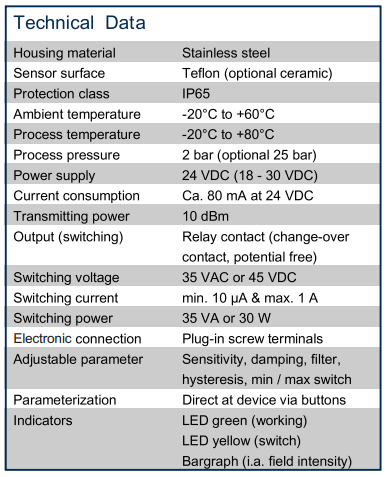
- Stainless steel housing
- PTFE sensor surface (ceramic optional)
- Wear-free operation
- IP65 enclosure protection
- Active self-monitoring for reliable operation
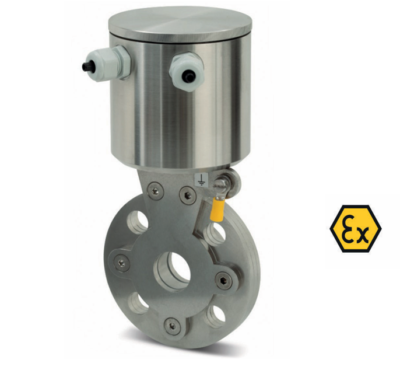
Its robust construction also supports optional high-pressure adapters and ATEX versions for hazardous areas up to Zone 20/21, making the sensor suitable for challenging process environments.
Benefits
Beyond detecting material movement, the FlowSwitch FS 510 helps improve the overall reliability of bulk solids handling systems by providing early warning of conveying problems before they affect production.
Key operational benefits include:
- Detects blocked pipelines before production is interrupted.
- Identifies loss of material flow in real time.
- Helps reduce unplanned downtime.
- Improves conveying process reliability.
- Supports preventive maintenance strategies.
- Easy to install on new or existing conveying systems.
- Requires no routine maintenance because the sensor does not contact the material.
- Suitable for harsh industrial environments where dust, abrasion, or difficult operating conditions limit the use of mechanical sensors.
For facilities handling powders, pellets, granules, or other dry bulk materials, continuous flow monitoring provides greater process visibility and allows operators to respond more quickly when abnormal conveying conditions occur.
Applications and Industries
The FlowSwitch FS 510 is designed for applications where confirming material movement is more important than measuring flow rate. It can be installed on a wide variety of conveying equipment to continuously verify that bulk solids are moving as expected and to detect interruptions at an early stage.
Typical Installation Locations
Thanks to its contactless sensing principle and flexible mounting options, the sensor can be integrated into many types of bulk material handling systems.
Typical installation locations include:
- Pneumatic conveying pipelines
- Screw conveyors
- Gravity pipes
- Chutes
- Belt conveyors
- Feed systems
- Downstream of screw feeders
- Other enclosed conveying equipment handling dry bulk solids
Because the sensor operates remotely and does not contact the product, installation is straightforward and retrofitting existing production lines is typically simple.
Industries
The FlowSwitch FS 510 is suitable for virtually any industry that transports powders, dusts, pellets, granules, or other bulk solids.
Common industries include:
- Cement
- Building materials
- Food processing
- Animal feed
- Chemical manufacturing
- Plastics
- Ceramics
- Glass manufacturing
- Mining and minerals
- Lime production
- Pharmaceuticals
- Pigment production
- Recycling
- Synthetic materials
- Textile manufacturing
- Detergent production
- Power generation
- Foundries
- Rubber processing
- Wood and pellet production
Its combination of contactless microwave technology, rugged stainless steel construction, and optional ATEX certification makes the FS 510 well suited for both standard industrial processes and demanding environments where dust, abrasion, or explosion protection requirements must be considered.
Technical Specifications
DYNAvel is designed to deliver reliable, continuous solids velocity measurement with minimal maintenance and seamless integration into industrial automation systems. The specifications below summarize the key information engineers and purchasing teams typically evaluate before selecting a solids velocity meter.
| Parameter | Specification |
| Measuring Principle | Non-contact solids velocity measurement |
| Measurement Method | Absolute transit time measurement |
| Measurement Type | Continuous online velocity measurement |
| Suitable Applications | Pneumatic conveying and free-fall processes |
| Measured Materials | Powders, dust, pellets, granules, and bulk solids |
| Analog Output | 4–20 mA |
| Communication | CAN-Bus |
| Maintenance | Maintenance-free operation |
| Calibration | No calibration required |
| System Integration | PLC, SCADA, and DYNAcon compatible |
Frequently Asked Questions
The following questions address the most common topics engineers and purchasing teams ask when evaluating a solids velocity meter for pneumatic conveying systems.
What is a solids velocity meter?
A solids velocity meter continuously measures the actual velocity of bulk materials moving through pneumatic conveying lines or free-fall processes. The measured velocity is used for process monitoring, conveying optimization, and, when combined with concentration measurement, continuous mass flow calculation.
How does DYNAvel measure solids velocity?
DYNAvel uses a non-contact absolute transit time measurement principle to calculate the velocity of moving bulk solids. Because the sensor does not contact the material, measurement remains stable without causing product contamination or mechanical wear.
Does DYNAvel require periodic calibration?
No. The measurement principle is based on absolute transit time measurement, eliminating the need for routine recalibration under normal operating conditions. This reduces maintenance requirements and minimizes production downtime.
Can DYNAvel measure powders, dust, and granules?
Yes. DYNAvel is suitable for a wide range of bulk materials, including powders, dust, pellets, granules, plastic resins, fly ash, and many other dry bulk solids commonly transported in pneumatic conveying systems.
Is DYNAvel suitable for pneumatic conveying systems?
Yes. The system is specifically developed for pneumatic conveying applications and free-fall processes where continuous velocity monitoring is essential for improving conveying efficiency, reducing energy consumption, and maintaining stable process conditions.
Can DYNAvel be integrated with PLC or SCADA systems?
Yes. DYNAvel supports CAN-Bus communication and 4–20 mA analog output, allowing straightforward integration with PLCs, SCADA platforms, and other industrial automation systems for real-time process monitoring.
Can DYNAvel be used for continuous mass flow measurement?
Yes. Velocity is one of the primary variables required to calculate mass flow. When DYNAvel is combined with a compatible solids concentration measurement system, it provides the data needed for continuous online mass flow measurement.
What industries commonly use DYNAvel?
DYNAvel is widely applicable in industries that handle dry bulk materials, including cement, mining, chemicals, plastics, food processing, battery materials, recycling, building materials, paper, and textile manufacturing.
Why is non-contact measurement important?
Non-contact measurement eliminates mechanical wear and prevents the sensor from affecting the conveyed material. This improves long-term reliability while helping preserve the quality of fragile or abrasive bulk solids.
How does continuous solids velocity measurement improve plant performance?
Real-time velocity data allows operators to optimize conveying air volume, reduce blower energy consumption, minimize pipeline abrasion, prevent material blockage, anAd maintain consistent conveying conditions. These improvements contribute to higher process efficiency, lower operating costs, and more reliable production.