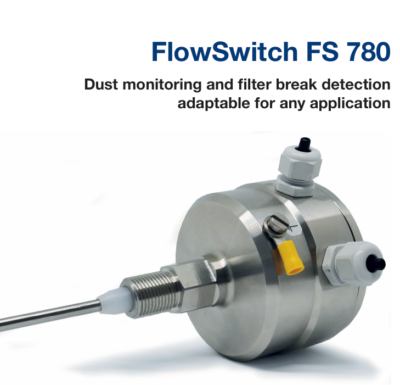
| Model | MUTEC FlowSwitch FS 710 Dust Monitor |
|---|---|
| Measuring Principle | Triboelectric |
| Application | Dust Monitoring & Filter Break Detection |
| Installation Position | Clean Air Side of Bag or Cartridge Filters |
| Process Temperature | -20°C to +150°C (Up to +180°C for ATEX version) |
| Process Pressure | 0–2 bar |
| Power Supply | 24 VDC |
| Output | 2 × Relay Contacts (Pre-Alarm & Main Alarm) |
| Protection Class | IP65 |
| ATEX Certification | Optional, up to Zone 20/21 |
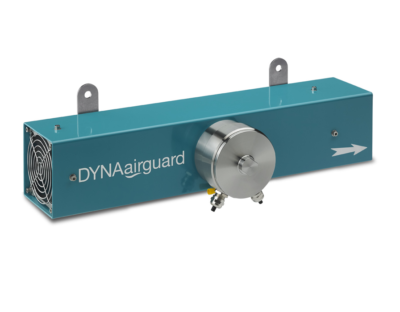
Industrial dust emissions can increase rapidly when a bag filter or cartridge filter develops cracks, tears, or installation defects. Even a small filter failure may contaminate recirculated air, increase housekeeping costs, and cause facilities to exceed environmental emission limits. The DYNAguard D Eco FlowSwitch FS 710 Dust Monitor is designed to continuously monitor dust concentration on the clean air side of filtration systems, allowing maintenance teams to detect filter damage before it becomes a costly problem. Using a reliable triboelectric dust monitor principle, the DYNAguard D Eco FS 710 provides early warning and alarm signals while remaining maintenance-free and easy to retrofit into existing ductwork.
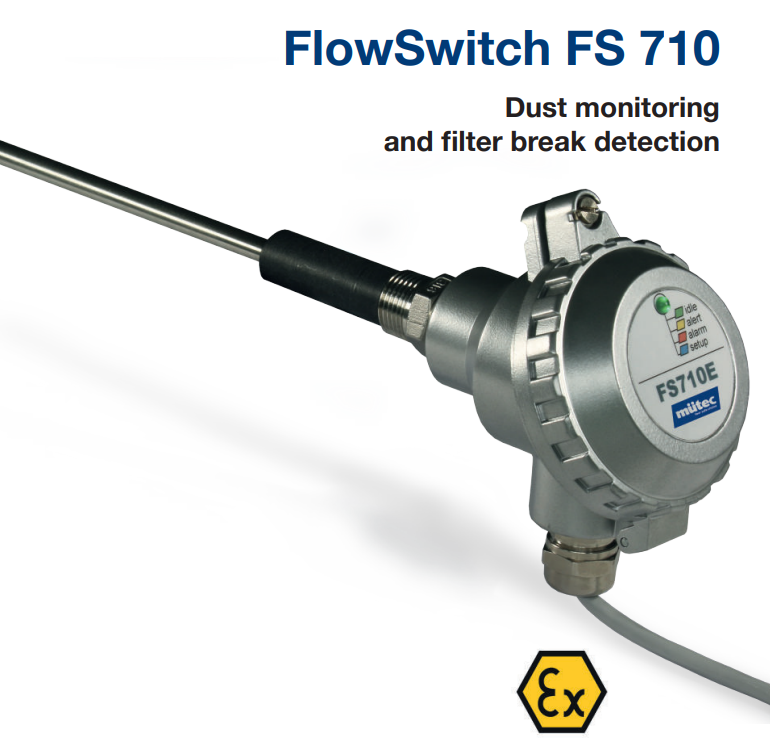
What Is the MUTEC DYNAguard D Eco FlowSwitch FS 710 Dust Monitor?
The MUTEC DYNAguard D Eco FlowSwitch FS 710 is an industrial dust monitor developed to detect filter leakage and filter breakage in dust collection systems. Installed on the clean air side of bag filters or cartridge filters, the sensor continuously monitors airborne dust particles and immediately detects abnormal increases caused by damaged filter elements.
Unlike periodic manual inspections, the FS 710 performs continuous online monitoring. This allows maintenance personnel to identify damaged filters before excessive dust escapes into the factory or the surrounding environment.
Typical filter failures detected by the FS 710 include:
- Cracked filter elements
- Broken filter media
- Installation or assembly errors
- Progressive filter wear
- Unexpected increases in dust emissions
Early detection enables maintenance teams to replace defective filters before production is interrupted or environmental compliance is affected. According to the catalog, this helps avoid unnecessary production losses while reducing contamination inside the facility.
Learn more: MUTEC products distributed by Ecozen
Installed on the Clean Air Side
The FS 710 is designed specifically for installation downstream of the dust filter, where only clean process air should normally be present.
This installation position offers several advantages:
- Detects filter damage immediately after it occurs.
- Monitors actual emissions leaving the filtration system.
- Protects recirculated air quality.
- Supports compliance with strict emission regulations.
Because the instrument measures dust concentration after filtration, it provides direct feedback on filter performance instead of simply monitoring process conditions.
For a complete overview of MUTEC dust detection solutions for bulk solids, explore the available technologies for dust monitoring and filter-break detection in bulk-solids processes.
Designed for Reliable Industrial Dust Monitoring
Many manufacturing facilities rely on baghouse or cartridge filtration systems to control airborne dust. When a filter begins to fail, operators often have little warning until visible dust appears or emission limits are exceeded.
The FS 710 addresses this challenge by providing continuous monitoring that reacts quickly to changing dust levels. According to the manufacturer, the instrument is particularly valuable in applications involving:
- Heavy dust contamination
- Air recirculation inside factories
- Strict environmental emission limits
- Dust recovery and reuse systems
These applications require dependable dust monitoring because undetected filter damage can affect production quality, workplace cleanliness, and environmental compliance simultaneously.
How the Triboelectric Dust Monitoring Principle Works
The FlowSwitch FS 710 operates using the triboelectric effect, a proven measurement principle for detecting moving dust particles inside industrial ducts.
Instead of measuring airflow or pressure, the sensor detects the electrical charge naturally carried by airborne particles as they travel through the duct. This allows the system to monitor actual dust movement while ignoring stationary dust deposits.
Triboelectric Measurement Principle
As dust particles move through process air, they continuously collide with each other and become electrically charged.
When these charged particles:
- Pass close to the sensor rod, or
- Make contact with the sensor rod,
a charge transfer occurs.
The FS 710 electronics detect this charge transfer and convert it into a dust monitoring signal.
An important characteristic of this measurement method is that only moving particles are detected. Dust that has settled or accumulated on surfaces does not influence the measurement, helping maintain stable operation over long periods.
This operating principle provides several practical advantages:
- Continuous real-time dust detection
- Fast response to changing dust concentration
- Stable measurements in industrial environments
- Reliable monitoring without being affected by dust deposits
These characteristics make the triboelectric principle particularly suitable for continuous filter condition monitoring.
Early Warning with Dual Alarm Outputs
One of the most valuable features of the FS 710 is its ability to warn operators before complete filter failure occurs.
According to the catalog, the instrument supports two independent alarm stages using two relay outputs:
Pre-Alarm
The pre-alarm identifies the first signs of filter wear before significant dust emissions occur.
This early warning enables maintenance teams to:
- Schedule inspections
- Plan filter replacement
- Avoid unexpected shutdowns
- Reduce emergency maintenance
Main Alarm
If a filter becomes damaged or breaks completely, the FS 710 activates the main alarm relay.
The alarm can be connected to plant control systems so operators can react immediately to prevent:
- Increased dust emissions
- Product contamination
- Excessive factory cleaning
- Environmental non-compliance
Because both alarm levels are available through relay outputs, integration into existing automation systems is straightforward.
Why Choose FlowSwitch FS 710 for Dust Filter Monitoring?
Selecting the right dust monitor is about more than detecting airborne particles. A monitoring system should help reduce maintenance costs, improve plant reliability, and support long-term environmental compliance.
The FlowSwitch FS 710 is designed with these objectives in mind.
Prevent Uncontrolled Dust Emissions
One of the primary purposes of the FS 710 is preventing uncontrolled dust release caused by damaged dust filters.
Without continuous monitoring, a broken filter may continue operating unnoticed until dust becomes visible or emission limits are exceeded.
The FS 710 helps operators respond much earlier by:
- Detecting abnormal dust concentration
- Identifying filter damage quickly
- Reducing uncontrolled emissions
- Protecting workplace cleanliness
According to the manufacturer, this minimizes unnecessary cleaning caused by damaged filters while helping maintain clean recirculated air.
Reduce Cleaning and Maintenance Costs
Unexpected filter failures often result in extensive housekeeping and emergency maintenance.
Continuous dust monitoring helps maintenance teams intervene before a minor filter defect develops into a larger operational issue.
Benefits include:
- Less emergency maintenance
- Reduced cleaning effort
- Lower production interruptions
- Better maintenance planning
- Improved filter replacement scheduling
Instead of reacting after contamination occurs, maintenance personnel receive early warning and can perform planned corrective actions.
Ensure Compliance with Emission Regulations
Many industries operate under strict dust emission requirements.
The catalog highlights that the FS 710 is particularly beneficial where external emission limits are tightly controlled or where clean recirculated air must be maintained inside production facilities.
By continuously monitoring dust levels behind the filter, the system helps operators:
- Maintain cleaner process air
- Support environmental compliance
- Monitor filter performance continuously
- Detect abnormal emissions before they become critical
For facilities that recycle filtered air back into production areas, reliable monitoring also helps protect equipment and working conditions.
Fast Detection with Maintenance-Free Operation
Beyond its detection capability, the FlowSwitch FS 710 is designed for long-term industrial operation.
According to the catalog, the instrument offers several practical advantages:
- Very fast response to filter damage
- Unaffected by dust buildup on the sensor rod
- Robust construction for harsh industrial environments
- Wear-free operation
- Maintenance-free design
- Simple automatic calibration
- Easy retrofit into existing exhaust ducts
These characteristics reduce the need for routine servicing while providing dependable performance over many years of operation. Automatic calibration further simplifies commissioning and minimizes operator workload.
Typical Applications of the FlowSwitch FS 710
The MUTEC FlowSwitch FS 710 is designed for continuous dust monitoring behind industrial filtration systems where early detection of filter damage is essential. By monitoring the clean air side of bag filters and cartridge filters, the instrument helps maintain process reliability, reduce maintenance costs, and support environmental compliance across a wide range of industries.
Monitoring Bag and Cartridge Filters
The primary application of the FlowSwitch FS 710 is filter break detection in baghouse and cartridge filter systems.
As filters age, they may develop small cracks, tears, or installation defects that allow dust particles to pass through the filtration system. Without continuous monitoring, these problems often remain unnoticed until dust emissions become visible or production areas require extensive cleaning.
Installing the FS 710 on the clean air side enables operators to continuously monitor filter performance and react before a damaged filter affects production.
Typical monitoring objectives include:
- Detecting damaged filter bags
- Identifying leaking cartridge filters
- Monitoring filter wear over time
- Verifying proper filter installation
- Providing continuous emission monitoring after filtration
The dual alarm system further improves maintenance planning by generating an early warning before complete filter failure occurs.
Dust Monitoring in Recirculated Air Systems
Many industrial plants reuse filtered air to improve energy efficiency and reduce operating costs. However, recirculated air must remain clean to avoid contaminating production equipment and indoor working environments.
The FlowSwitch FS 710 continuously monitors dust concentration after the filtration stage, providing operators with confidence that the returned air remains within acceptable conditions.
Continuous monitoring is particularly valuable because it helps:
- Maintain clean recirculated air
- Detect unexpected filter leakage
- Reduce airborne dust inside production areas
- Improve workplace cleanliness
- Protect downstream equipment from dust contamination
According to the manufacturer, dust monitoring is especially important in facilities where air is recirculated back into the factory.
Industrial Processes with Strict Emission Limits
Environmental regulations continue to become more demanding across many industries. Even a small filter defect can increase emissions beyond permitted levels if it is not detected promptly.
The FlowSwitch FS 710 helps facilities maintain better control over particulate emissions by providing continuous monitoring and rapid alarm notification.
Industries that commonly benefit from this approach include:
- Cement plants
- Chemical manufacturing
- Fertilizer production
- Food processing
- Pharmaceutical manufacturing
- Glass production
- Steel production
- Wood processing
- Aluminum production
- Building materials
- Mills
- Pulp and paper
- Power plants
- Surface cleaning applications
These industries often operate dust collection systems where continuous monitoring can reduce environmental risks while supporting reliable production.
Technical Specifications of MUTEC FlowSwitch FS 710
The following technical specifications are provided by MUTEC to help engineers evaluate compatibility with new or existing dust collection systems.
| Parameter | Specification |
|---|---|
| Measuring Principle | Triboelectric |
| Application | Dust Monitoring & Filter Break Detection |
| Installation Position | Clean Air Side |
| Housing Material | Aluminum |
| Sensor Rod Material | Stainless Steel (1.4571) |
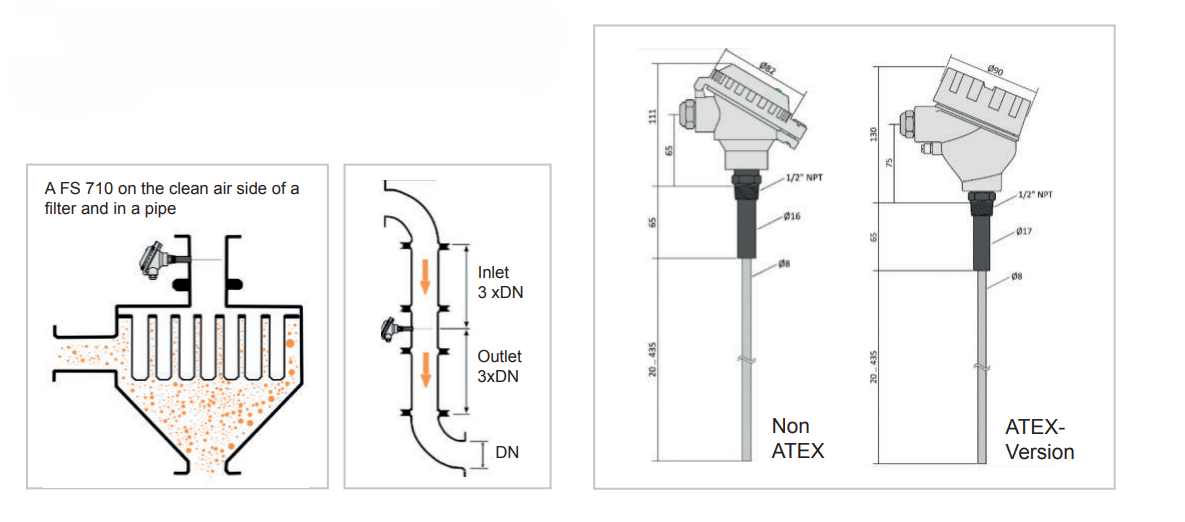
| Rod Length | 250 mm, 500 mm or Customized |
| Mechanical Connection | NPT 0.5″ |
| Ambient Temperature | -20°C to +50°C |
| Ambient Temperature (ATEX) | -10°C to +70°C |
| Process Temperature | -20°C to +150°C |
| Process Temperature (ATEX) | -10°C to +180°C |
| Process Pressure | 0–2 bar |
| Process Pressure (ATEX) | 0.8–1.1 bar |
| Protection Class | IP65 |
| Power Supply | 24 VDC |
| Current Consumption | Max. 50 mA (<2 W) |
| Outputs | 2 Relay Contacts |
| Switching Voltage | 60 VAC / 60 VDC |
| Maximum Switching Current | 100 mA |
| Switching Power | 6 W |
| Adjustable Parameter | Sensitivity |
| Calibration | Automatic (10 minutes) |
| Status Indicator | Multi-color LED (Non-ATEX Version) |
| ATEX Version | Optional up to Zone 20/21 |
The sensor is installed by welding a threaded socket onto the duct and inserting the sensor rod through a small opening. The manufacturer recommends using a rod length of at least one-third of the duct diameter while ensuring the rod does not touch the opposite side of the pipe. Automatic calibration is performed in clean air over approximately ten minutes, after which the sensitivity can be adjusted if required. The compact installation design also makes retrofitting existing duct systems straightforward.
Why Engineers Select MUTEC FlowSwitch FS 710
Industrial maintenance teams require monitoring equipment that delivers dependable performance with minimal intervention. The FlowSwitch FS 710 combines continuous dust monitoring with a rugged design suitable for demanding industrial environments.
Compared with periodic manual inspections, continuous online monitoring enables operators to identify developing filter problems before they escalate into expensive production interruptions or environmental incidents.
Engineers choose the FlowSwitch FS 710 because it offers:
- Continuous monitoring of dust concentration behind filtration systems
- Fast detection of damaged or worn filter elements
- Reliable triboelectric measurement of moving dust particles
- Measurement unaffected by dust deposits on the sensor rod
- Maintenance-free and wear-free operation
- Automatic calibration for simplified commissioning
- Easy retrofit into existing exhaust ducts
- Two relay outputs for pre-alarm and main alarm functions
- Robust industrial construction for long service life
- Optional ATEX version for hazardous areas up to Zone 20/21
These features make the FS 710 a practical solution for facilities seeking to improve filter monitoring, reduce unplanned maintenance, and support compliance with industrial emission requirements.
Whether installed in a cement plant, food processing facility, chemical factory, pharmaceutical production line, or power generation site, the MUTEC FlowSwitch FS 710 provides continuous visibility into filter condition so maintenance teams can respond before minor filter wear develops into a significant operational problem.
For manufacturers looking to strengthen dust emission control while minimizing downtime and maintenance effort, the MUTEC FlowSwitch FS 710 Dust Monitor delivers a reliable, easy-to-install solution for long-term industrial filter monitoring.
Catalogue