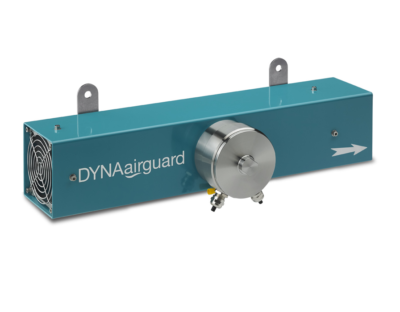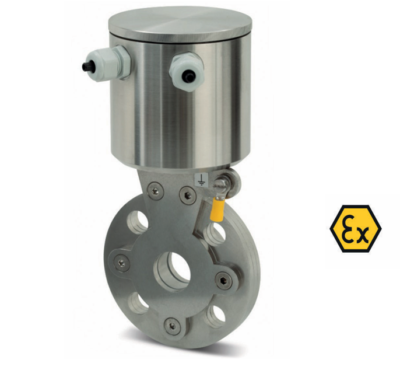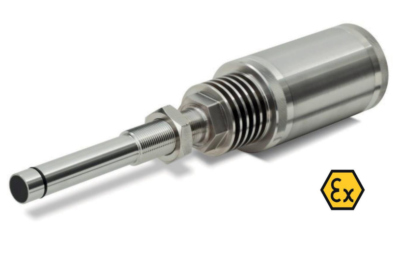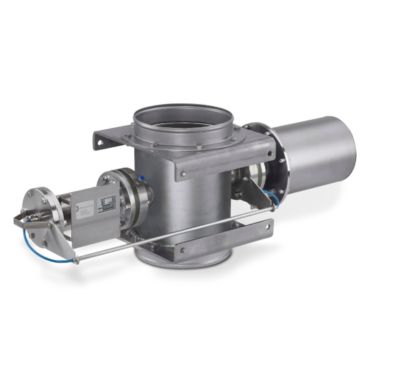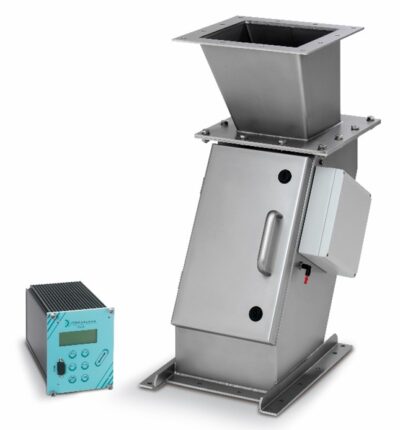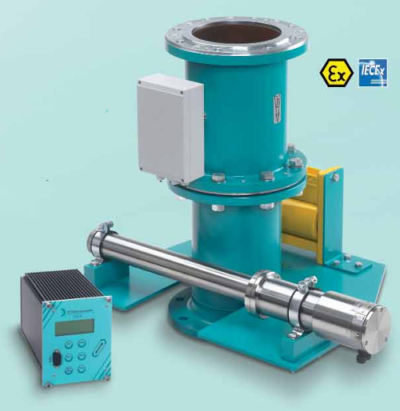
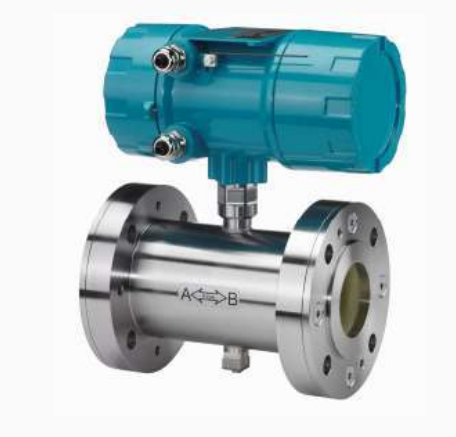
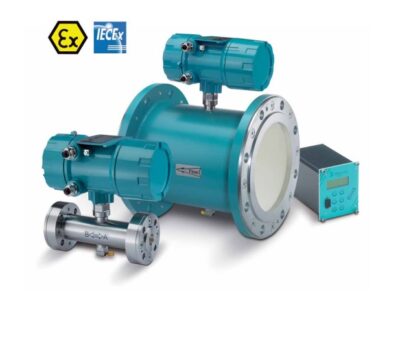
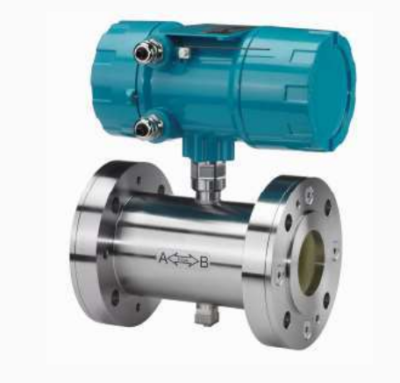
| MODEL | DYNAmass MF 5000 – Solids Flow Meter | |
|---|---|---|
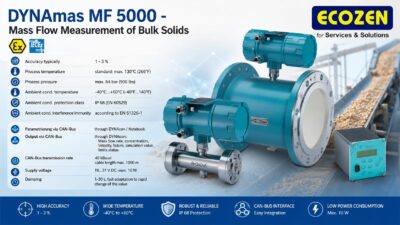
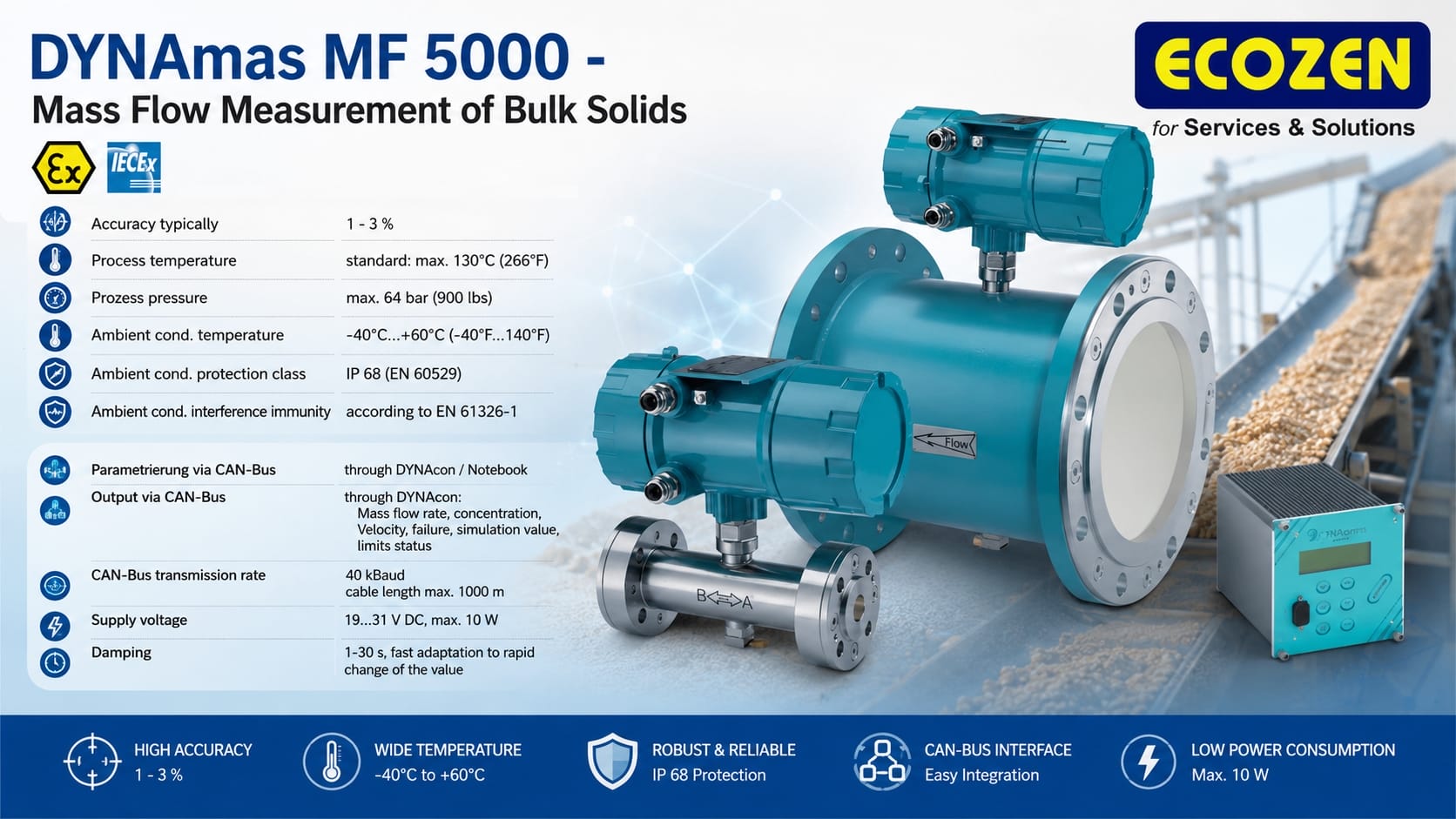
| Accuracy typically | 1 – 3 % | |
| Process temperature | standard: max. 130°C (266°F) | |
| Prozess pressure | max. 64 bar (900 lbs) | |
| Ambient cond. temperature | -40°C…+60°C (-40°F…140°F) | |
| Ambient cond. protection class | IP 68 (EN 60529) | |
| Ambient cond. interference immunity | according to EN 61326-1 | |
| Parametrierung via CAN-Bus | through DYNAcon / Notebook | |
| Output via CAN-Bus | through DYNAcon: Mass flow rate, concentration, Velocity, failure, simulation value, limits status | |
| CAN-Bus transmission rate | 40 kBaud cable length max. 1000 m | |
| Supply voltage | 19…31 V DC, max. 10 W | |
| Damping | 1-30 s, fast adaptation to rapid change of the value | |
Solid flow meter DYNAmas MF 5000 – Accurate bulk solids flow measurement is essential for maintaining stable production, reducing material losses, and improving process efficiency. However, measuring the mass flow of powders, dust, granules, and pellets in pneumatic conveying lines or free-fall processes remains challenging because conveying conditions can change continuously during operation.
The DYNAmas MF 5000 is an inline bulk solids mass flow meter designed for continuous, real-time measurement of dry bulk material flow. By determining material concentration and conveying velocity independently, the system continuously calculates the actual mass flow rate without interrupting production. This enables operators to monitor throughput, optimize process control, and improve production transparency across a wide range of industries.
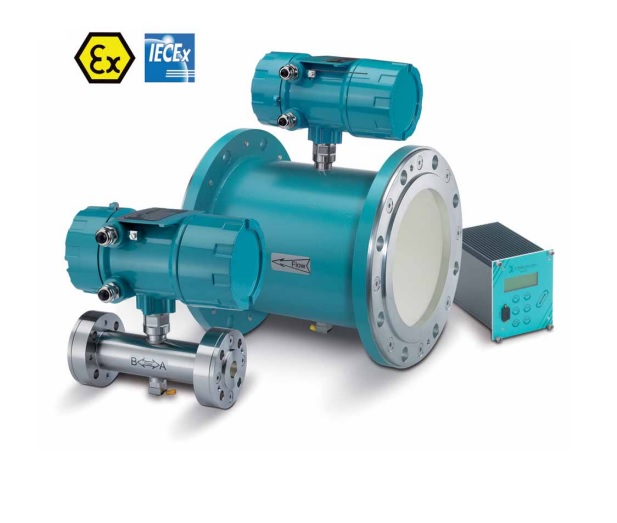
What Is the DYNAmas MF 5000 Bulk Solids Mass Flow Meter?
The DYNAmas MF 5000 is an inline bulk solids mass flow meter that continuously measures the mass flow rate of dry bulk materials in pneumatic conveying systems and free-fall applications.
Unlike weighing systems that require interruptions or mechanical contact with the material, the DYNAmas MF 5000 performs continuous online measurement directly inside the process. The measured values are immediately available for monitoring, automation, and process optimization, allowing operators to react quickly to process variations while maintaining consistent product quality.
The system is designed for industries where accurate solids flow measurement directly affects production efficiency, material consumption, and quality control. Since measurements are performed continuously, operators no longer need to rely solely on manual sampling or periodic verification to estimate production throughput.
The DYNAmas MF 5000 is suitable for measuring many types of dry bulk materials, including:
- Powder
- Dust
- Granules
- Pellets
- Other free-flowing bulk materials
It can be installed in two common process configurations:
- Pneumatic conveying systems
- Free-fall material transfer
This flexibility allows the instrument to support numerous conveying and production processes without changing the overall process layout.
Learn more: MUTEC PRODUCTS distributed by ECOZEN
Why continuous inline mass flow measurement matters
Real-time measurement provides far more process visibility than periodic manual checks. Instead of discovering production deviations after a batch has finished, operators can identify changes as they occur and respond immediately.
Typical production benefits include:
- Continuous throughput monitoring
- Improved process automation
- More consistent dosing and batching
- Better production transparency
- Faster response to abnormal process conditions
- Reduced product losses caused by unstable conveying
For facilities implementing digital manufacturing strategies, continuous inline data also supports centralized monitoring and integration into modern process control systems, making production more transparent and easier to optimize over time.
How Does the DYNAmas MF 5000 Work?
The DYNAmas MF 5000 calculates mass flow by measuring material concentration and conveying velocity independently, then combining both values to determine the actual mass flow rate in real time.
Instead of estimating flow from only one process variable, the system separates the measurement into two independent components before performing the mass flow calculation.
Bulk Material
        │
        ▼
Capacitive Sensor
        │
        ▼
Material Concentration
        +
Velocity Measurement
        │
        ▼
Mass Flow Calculation
        │
        ▼
Continuous kg/h Output
This measurement concept allows the instrument to provide continuous online mass flow information without interrupting the conveying process. According to the DYNA overview, the DYNAmas uses capacitive measurement to determine product concentration and measures transport velocity separately before calculating the mass flow rate.
Capacitive measurement of material concentration
The first step is determining how much bulk material is present inside the conveying line.
The DYNAmas MF 5000 uses a capacitive measuring principle to continuously detect changes in material concentration as product passes through the measuring section. Because the measurement is performed continuously, concentration variations caused by changing process conditions are detected immediately.
This enables the system to produce stable measurement data for a wide variety of dry bulk materials, including powders, dust, granules, and pellets.
Independent velocity measurement
Knowing material concentration alone is not enough to determine mass flow.
The system therefore measures the conveying velocity independently from the concentration measurement. By treating these two variables separately, the instrument can accurately calculate throughput even when conveying conditions change during operation.
This independent measurement approach is particularly valuable in pneumatic conveying systems where conveying air velocity may fluctuate because of process adjustments, blower performance, or changing product characteristics.
Continuous mass flow calculation
After both values are available, the DYNAmas MF 5000 continuously calculates the actual mass flow rate and outputs the measurement for monitoring or process control.
The resulting data can be used for:
- Continuous throughput monitoring
- Process control
- Production optimization
- Material balancing
- Automated process adjustment
- Quality monitoring
Since the calculation is performed continuously, operators receive real-time process information instead of delayed production data.
Why is the DYNAmas MF 5000 independent from changing conveying velocity?
This is one of the key advantages of the DYNAmas measurement principle.
Many solids flow measurement technologies become less reliable when conveying velocity changes because they infer mass flow from a single measured parameter.
The DYNAmas MF 5000 follows a different approach by measuring:
- Material concentration
- Conveying velocity
independently before calculating mass flow.
As a result, changes in conveying speed do not directly distort the mass flow calculation, allowing the system to deliver stable measurements under varying conveying conditions. This independent measurement concept is one of the distinguishing characteristics of the DYNAmas product family for bulk solids flow measurement.
Key Features and Benefits of the DYNAmas MF 5000
The DYNAmas MF 5000 combines continuous inline measurement with a non-contact measuring principle to deliver reliable bulk solids mass flow data while minimizing maintenance and simplifying system integration.
Unlike mechanical measuring devices that may be affected by wear, the DYNAmas MF 5000 measures bulk solids continuously without introducing moving parts into the material stream. This design improves long-term measurement stability while supporting modern automated production environments through multiple communication and output options.
Key Features
Independent concentration and velocity measurement
- Technical reason: The instrument measures material concentration and conveying velocity separately before calculating the actual mass flow.
- Operational benefit: Stable mass flow measurement even when conveying conditions vary.
Continuous online measurement
- Technical reason: Measurement is performed continuously during operation without interrupting the conveying process.
- Operational benefit: Operators receive real-time throughput data for faster process decisions and improved production control.
Non-contact measuring principle
- Technical reason: The sensing principle minimizes direct mechanical interaction with the flowing material.
- Operational benefit: Reduced wear, lower maintenance requirements, and consistent long-term performance.
Easy integration into automation systems
- Technical reason: The DYNAmas MF 5000 supports analogue outputs, relay outputs and CAN Bus communication for process integration.
- Operational benefit: Simple connection to PLC, SCADA, or existing plant control systems for centralized monitoring and control.
Flexible installation for industrial processes
- Technical reason: The system is designed for both pneumatic conveying lines and free-fall installations.
- Operational benefit: One measurement platform can be applied across multiple conveying configurations with minimal process modifications.
Configurable for demanding operating environments
- Technical reason: Various material options, pressure ratings, operating temperatures, and explosion-protected versions are available depending on the application.
- Operational benefit: Easier adaptation to different industries and process requirements without changing the overall measuring principle.
Benefits
For production engineers, continuous bulk solids flow measurement provides more than just a mass flow value. It delivers real-time process information that can be used to optimize production, improve quality consistency, and support data-driven process control.
Key operational benefits include:
- Improve process stability through continuous mass flow monitoring.
- Detect process deviations before they affect product quality.
- Increase throughput visibility across conveying systems.
- Support accurate batching and dosing operations.
- Reduce material losses caused by unstable conveying conditions.
- Lower maintenance requirements through a non-contact measuring concept.
- Enable continuous data collection for production analysis and optimization.
- Integrate measurement data into modern automation and Industry 4.0 environments.
For purchasing teams, these advantages also translate into lower lifecycle costs. A reliable inline measurement system helps reduce unplanned downtime, minimizes manual inspection, and provides long-term operational value through continuous production monitoring rather than periodic measurements.
Applications and Industries
The DYNAmas MF 5000 is designed for continuous bulk solids flow measurement wherever dry materials are transported pneumatically or by gravity.
Because the measurement principle is based on independently determining material concentration and conveying velocity, the system can be applied across a wide range of production processes that require accurate throughput monitoring.
Typical Applications
The DYNAmas MF 5000 supports many production tasks where knowing the actual mass flow in real time improves process control and operational efficiency.
Typical applications include:
- Continuous throughput measurement
- Process monitoring
- Process automation
- Batch control
- Dosing verification
- Material balancing
- Production monitoring
- Loading and unloading processes
- Pneumatic conveying systems
- Free-fall material transfer
Instead of relying on estimated production rates or manual sampling, operators receive continuous mass flow information that can be used to optimize equipment performance and maintain stable production.
Industries
The DYNAmas MF 5000 is suitable for many industries that handle dry bulk materials.
Common applications include:
- Cement and building materials
- Lime processing
- Fly ash handling
- Chemical processing
- Mineral processing
- Plastics and polymer pellets
- Food processing
- Flour and grain handling
- Fertilizer production
- Recycling and bulk material recovery
These industries often transport powders, dust, granules, or pellets through pneumatic conveying systems or free-fall processes, making continuous inline mass flow measurement an important part of process optimization, quality assurance, and production monitoring.
With its flexible installation options and continuous online measurement capability, the DYNAmas MF 5000 can be integrated into both new production lines and existing conveying systems where accurate bulk solids throughput data is required for efficient plant operation.
Technical Specifications
The DYNAmas MF 5000 combines a capacitive measuring principle with industrial-grade communication, flexible installation options, and configurable materials to meet a wide range of bulk solids flow measurement applications.
While measuring principle determines how accurately a flowmeter performs, technical specifications determine whether it is suitable for a specific process. The DYNAmas MF 5000 offers multiple configuration options, allowing engineers to select the appropriate sensor construction, process connection, pressure rating, operating temperature, and communication interface for their conveying system.
| Specification | Description |
|---|---|
| Measuring Principle | Capacitive mass flow measurement |
| Measurement Type | Continuous inline bulk solids mass flow measurement |
| Installation | Pneumatic conveying and free-fall applications |
| Measured Variables | Material concentration and conveying velocity |
| Measurement Output | Continuous mass flow rate |
| Communication | CAN Bus for DYNAcon communication unit and PLC integration |
| Signal Outputs | Analogue output and relay output (configuration dependent) |
| Process Connections | Multiple flange standards and nominal sizes available |
| Sensor & Housing Materials | Various material options for different industrial environments |
| Operating Conditions | Configurable for different pressure and temperature requirements |
| Explosion Protection | Optional IECEx / ATEX versions for hazardous areas |
| Integration | Compact design for new or existing process lines |
Why these specifications matter
Choosing the right bulk solids mass flow meter involves more than comparing measurement principles. Engineers must ensure that the instrument matches the conveying system, environmental conditions, and plant automation requirements.
The DYNAmas MF 5000 addresses these practical considerations through its configurable mechanical construction and communication options. Its compact design simplifies installation in existing production lines, while CAN Bus communication and industrial outputs enable straightforward integration into PLC- or SCADA-based automation systems. Optional explosion-protected versions also make the system suitable for hazardous industrial environments where regulatory compliance is required.
Why Choose the DYNAmas MF 5000?
The DYNAmas MF 5000 is a practical choice for manufacturers that require reliable, continuous bulk solids mass flow measurement with minimal maintenance and easy integration into automated production systems.
Unlike many conventional solids flow measurement technologies, the DYNAmas MF 5000 independently measures material concentration and conveying velocity before calculating the actual mass flow rate. This measurement concept provides stable performance even when conveying velocity changes, making it well suited for dynamic industrial processes.
What makes the DYNAmas MF 5000 different?
Key advantages include:
- Independent measurement of material concentration and conveying velocity.
- Continuous online mass flow monitoring without interrupting production.
- Non-contact measuring principle with no moving components in the product stream.
- Compact design for easy installation in both new and existing plants.
- Simple calibration and straightforward commissioning.
- Integration with PLC systems through the DYNAcon communication unit.
- Suitable for applications ranging from relatively low to very high mass flow rates.
- Available in configurations for demanding industrial and hazardous environments.
When should you use the DYNAmas MF 5000?
The DYNAmas MF 5000 is particularly suitable when a process requires continuous and reliable monitoring of dry bulk material flow.
Typical materials include:
- Powder
- Dust
- Granules
- Pellets
- Other free-flowing bulk solids
Typical process conditions include:
- Pneumatic conveying systems
- Free-fall material transfer
- Continuous production lines
- Automated batching and dosing
- Throughput monitoring
- Process optimization
- Material balancing
By providing continuous mass flow information in real time, the system helps operators improve process transparency, maintain product consistency, and support data-driven production decisions.
Frequently Asked Questions
Can the DYNAmas MF 5000 measure different types of bulk solids?
Yes. The system is designed for a wide range of dry bulk materials, including powders, dust, granules, pellets, and other free-flowing solids. Configuration can be adapted to suit different applications.
Does the instrument require frequent calibration?
No. The DYNAmas MF 5000 is designed for straightforward calibration during commissioning. Once properly configured, it provides continuous online measurement with minimal routine intervention.
Can it be installed in existing conveying systems?
Yes. Its compact design allows the instrument to be integrated into both new installations and existing pneumatic conveying or free-fall systems with minimal process modification.
How is the DYNAmas MF 5000 different from impact flow meters?
Impact flow meters estimate mass flow based on the force generated when material strikes a sensing surface, making measurement performance more sensitive to changes in material behavior and conveying conditions. In contrast, the DYNAmas MF 5000 independently measures material concentration and conveying velocity before calculating mass flow, helping maintain stable measurement even when transport velocity changes.
Is the DYNAmas MF 5000 suitable for both pneumatic conveying and free-fall applications?
Yes. The system is specifically designed for continuous inline mass flow measurement in both pneumatic conveying systems and free-fall processes, making it suitable for a broad range of bulk solids handling applications.
Catalogue